

From the Seminole Wars to Juneteenth: Florida’s Hidden Connection to America’s Freedom Story


From the Seminole Wars to Juneteenth: Florida’s Hidden Connection to America’s Freedom Story
Fort Pierce, FL — As communities across America prepare to celebrate Juneteenth, growing attention is being placed on Florida’s overlooked role in the long struggle for African American freedom.
Historians and cultural advocates are highlighting the direct connection between the Seminole Wars, the Civil War, the Freedmen’s Bureau, and the birth of Juneteenth.
Long before emancipation became national policy, Florida served as a battleground over slavery and freedom. During the Seminole Wars, enslaved Africans escaped plantations and joined Seminole communities, creating alliances now remembered through the history of the Black Seminoles. These conflicts represented some of the earliest organized resistance to slavery in the American South.
Military leaders later associated with emancipation and Reconstruction also shared Florida ties. William Tecumseh Sherman spent time in Florida after graduating from West Point, including service connected to the frontier military system near Fort Pierce. Oliver Otis Howard later emerged as one of the Union Army’s leading commanders before overseeing Reconstruction efforts as head of the Freedmen’s Bureau.
Following the Civil War, Sherman issued Special Field Orders No. 15, setting aside land for formerly enslaved families along the southeastern coast. Howard then led federal efforts to establish schools, churches, and economic opportunities for freedmen throughout the South. On June 19, 1865, Union General Gordon Granger arrived in Galveston to announce General Order No. 3, informing enslaved African Americans in Texas of their freedom — now commemorated nationally as Juneteenth.
“This history shows that Juneteenth was not just a Texas event,” said cultural historian and advocate Derek Boyd Hankerson. “The road to Juneteenth also passed through Florida, the Seminole frontier, the Civil War, and Reconstruction.”
The announcement also highlights the role of Black churches and Baptist leadership during Reconstruction. Ministers and community leaders throughout Florida such as Rev. J. P. Hankerson, Derek’s great-great-grandfather, and other ministers worked alongside the War Department’s Freedmen’s Bureau to build schools, conventions, and institutions that helped formerly enslaved families transition into citizenship and self-governance.
The story further connects to the modern Gullah Geechee Cultural Heritage Corridor, which stretches from North Carolina to Florida. Many of the same coastal communities affected by slavery, emancipation, and Reconstruction became centers of African American land ownership, worship, language preservation, and cultural survival.
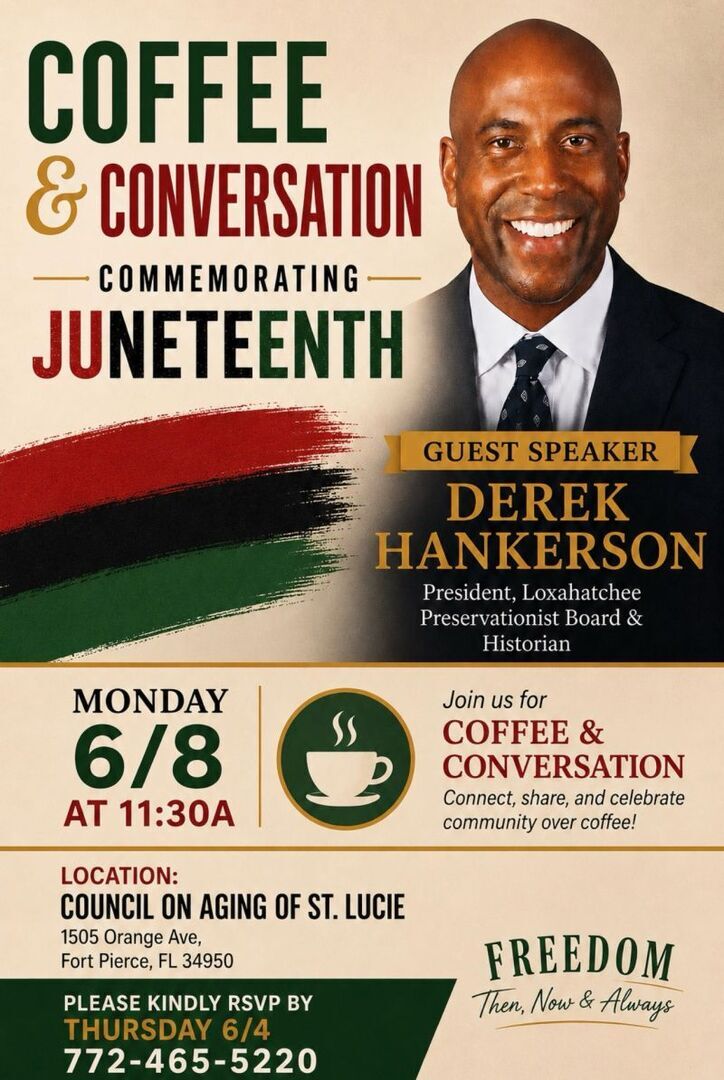
The public is invited to continue this important conversation during the Council on Aging of St. Lucie’s upcoming “Coffee & Conversation: Commemorating Juneteenth” event on Monday, June 8, 2026, at 11:30 a.m. at the Council on Aging of St. Lucie, 1505 Orange Avenue, Fort Pierce, Florida. The event will feature guest speaker Derek Boyd Hankerson and discussions surrounding Florida’s connection to Juneteenth, freedom, and African American history.
As Juneteenth celebrations continue to grow nationwide, organizers hope more attention will be given to Florida’s role in shaping America’s freedom story — from the Seminole Wars to Reconstruction and beyond.
